ONE WOMAN, SEVERAL DOORWAYS
Money. Art. Community. A garage-sale find.
The whole profile only makes sense when those strands are allowed to sit beside one another.
“The album becomes both homage and critique, embracing beauty unapologetically while unsettling the historical power embedded within it.”
Phoebe, on A Bouquet of Flowers.
THE USEFUL KIND OF WHOLE PERSON
It would be much easier to introduce Phoebe with one job title.
It would also miss the point.
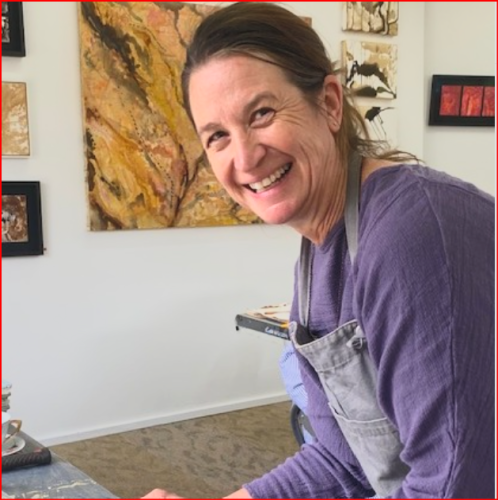
At the 2026 Orana Every Woman Festival, Phoebe appeared in one part of the week through financial counselling and conversations about money.
In another part of the same Festival, she was an artist.
And around the edges of both, she was doing something I have watched her do repeatedly: noticing, connecting, encouraging, sharing something useful, introducing somebody, backing the idea and helping the next thing happen.
There are people whose contribution makes more sense when you stop trying to separate the practical parts of them from the creative ones.
Phoebe is one of those people.
THE MONEY STORY
Money is rarely only about money.
One of the Festival conversations was called The Money Story.
The idea was simple. Most of us arrive in adulthood already carrying stories about money: things we heard growing up, things families did or did not discuss, embarrassment, fear, habits, assumptions and all the quiet worries people can carry without anybody around them knowing.
Phoebe and fellow financial counsellor Kelly Salisbury brought professional knowledge into that conversation.
But what stayed with me afterwards was not a financial fact sheet.
It was what happened because the conversation was taking place inside a Festival rather than behind an information booth.
Women talked. Questions surfaced. Warm referrals happened. Practical follow-up became possible.
Phoebe later reflected on the value of that warm, creative setting: conversations and referrals happened there that were unlikely to have begun in a more formal service environment.
Sometimes the service already exists. What people need is a more human doorway into it.
That is one of the things the Festival keeps teaching me.
THEN SHE MADE ART
The same woman was also asking what deserves to be preserved.
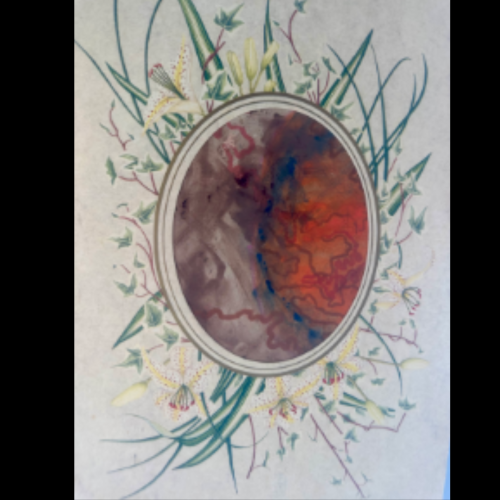
For the inaugural Inspired by Her exhibition, Phoebe created A Bouquet of Flowers.
The work inhabits the ornate Victorian photograph album, using its floral frame as both inheritance and interrogation.
Inside that decorative language sit abstracted landscapes, cattle, the Sydney Opera House, textures and patterns: pieces of a contemporary regional life that do not resolve themselves into one simple identity.
Phoebe describes the series as an inquiry into belonging, displacement and the layered identities of a woman living in Western NSW.
The old album frame matters because historically it did more than make a photograph pretty. Ornament gave things status. It suggested that what sat inside the frame was worthy of display and preservation.
Phoebe turns that idea around.
What happens when contemporary regional experience is placed inside that frame? Who decided what counted as cultured in the first place? Does the decoration give the image authority, or reveal how constructed those ideas of authority have always been?
The financial counsellor and the artist are not opposites. Both are interested in the stories we inherit and what happens when we look at them properly.
THE DOLLS
And then there was a plastic tub at a garage sale.
This may be my favourite Phoebe story because it is so ordinary.
Phoebe was out on a garage-sale trail when she came across a large plastic tub filled with dolls.
They were not mass-produced collectibles. They were handmade dolls dressed carefully in traditional clothing from countries around the world.
The dolls had belonged to a woman named Betty, who had been part of a local CWA branch.
Each year the women would choose a country to learn about. They explored its culture, history and traditions, and Betty made a doll in traditional dress as part of that shared learning.
Phoebe saw the tub and understood that it was not simply a tub of old dolls.
She knew I was working on the women’s Festival. She explained why they would matter there.
Through one of those regional chains of people knowing people, the dolls eventually came to me and became part of the 2026 Festival.
They carried women’s hands, labour, friendship, curiosity and creativity into another room long after Betty was gone.
Phoebe did not make the dolls. Her contribution was recognising that they were worth noticing.
I think that matters.
Culture does not only survive because somebody created it.
Sometimes it survives because somebody else recognised it.
THE WHOLE PICTURE
Maybe there were never separate Phoebes at all.
There is the financial counsellor, sitting with the stories people carry about money.
There is the artist, questioning the frames through which we decide what belongs and what deserves preserving.
There is the friend at a garage sale who sees a box of handmade objects and understands that somebody’s years of curiosity and care should not disappear into a skip.
And there is the person I know through Social Gain who keeps showing up around good ideas, making connections and helping in ways that are often easier to feel than to put into a job description.
Look closely and it is the same practice.
Attention.
Dignity.
A willingness to look beyond the obvious use or label of something.
A belief that what people carry deserves to be taken seriously.
Sometimes seeing the whole person simply means refusing to crop out the parts that do not fit the easy caption.
— Sharon