ONE WOMAN, A LONGER STORY
Dubbo. Wiradjuri language. Teaching. The Workbooks. Inspired by Her.
What happened at the Festival is one point in a much longer life of keeping knowledge moving.
THE BOOKS
Wiradjuri Workbooks
Seven learning workbooks created by Aunty Diane Riley-McNaboe and Associate Professor Lynette Riley to help language and cultural knowledge move through children, families, carers and classrooms.
THE CONNECTION
Pearl → Wambuul → Aunty Di
At Inspired by Her, history, Country, artwork and living cultural memory met in the same room.
THE ROOM
I knew the moment before I knew the whole story.
At the 2026 Inspired by Her opening, Aunty Di sang Welcome to Country.
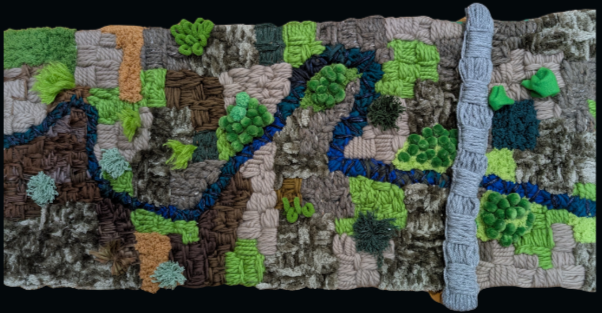
She also spoke about Pearl Gibbs, the Aboriginal rights activist whose life and Dubbo story had inspired Sophia Johnson’s textile work Wambuul: Echoes of the Turning Tide.
It was one of those moments where the artwork stops being simply an object on a wall.
Country was present. Pearl’s name was present. Sophia’s response was present. And Aunty Di brought living knowledge into the room.
But Aunty Di does not belong in this story simply because she appeared at our event.
Her work in this region began long before that room.
LANGUAGE IN WHISPERS
As a child, language was something she heard cautiously.
Aunty Diane Riley-McNaboe is a Dubbo-born Wiradjuri and Gamilaroi woman.
She has described growing up hearing Elders use Wiradjuri words in fragments rather than full conversations. Language was sometimes spoken behind buildings, near trees or away from children because families carried the very real fear that children could be removed if they were seen to be learning culture and language.
That history makes what came later particularly significant.
Aunty Di did not inherit an easy, uninterrupted pathway into fluency. She worked for it: workshops, regular language gatherings, study and the resources that were available at the time.
The work of people including Uncle Stan Grant Snr and linguist John Rudder, who documented Wiradjuri language, became part of that pathway.
What had once been spoken quietly became something she would teach openly.
TEACHING IT HERE
One of the first Wiradjuri language teachers at Dubbo TAFE.
Aunty Di went on to become one of the first teachers at Dubbo TAFE teaching Wiradjuri language.
That sentence is easy to read quickly.
It is worth reading slowly.
A language that people in her childhood had reason to protect through silence became a language she was standing in an educational institution and teaching.
And it was happening here, in Dubbo.
The significance of that is bigger than vocabulary. Language carries the relationships between people, Country, family, place, animals, seasons and the names through which the landscape is understood.
You begin hearing the place differently.
THE WIRADJURI WORKBOOKS
Then Aunty Di and her sister put some of that knowledge into books people could actually use.
With her sister, Associate Professor Lynette Riley, Aunty Di created the Wiradjuri Workbooks, a seven-part series designed to make language and cultural learning practical, welcoming and accessible.
The books grew during the COVID period, when separation from family made questions of connection particularly urgent.
They were created with an especially important group in mind: Aboriginal children in out-of-home care, including children living away from their own Country, family and cultural networks.
The idea was not simply to hand a child a language textbook.
The workbooks use activities, games and shared learning around sounds, numbers, family, colours, body parts, animals, seasons, symbols and other elements of Wiradjuri language and culture.
They are designed to be used with somebody else: a parent, grandparent, carer, teacher or family member. Conversation is part of the learning.
A book becomes another way for knowledge to travel when the person who knows cannot always be sitting beside the child who needs it.
The University of Sydney supported the development of the workbooks through its work around lifelong connections for children in permanent care, and SBS Learn has made workbook resources available for educators.
BACK TO WAMBUUL
Which brings us back to the river.
Wambuul is not simply another name printed beside Macquarie River.
Language changes the way place is understood because the words themselves belong to a much older relationship with that place.
That is why Aunty Di’s presence beside Sophia’s artwork mattered.
Sophia had created a contemporary response to Pearl Gibbs, the river and a bridge carrying Pearl’s name.
Aunty Di brought something different: living cultural knowledge and a relationship with this place that cannot be produced by research alone.
CARRYING IT FORWARD
The story does not finish when something has been remembered.
Pearl Gibbs belongs to an earlier generation and a different life. Aunty Di’s story is her own.
What connects them in this particular room is continuation.
One woman’s history inspired an artwork. Another woman brought language, Country and memory into the space around it.
Outside that room, Aunty Di has spent years doing the slower work: learning, teaching, creating resources and giving other people a way in.
That is significant to Dubbo.
And it deserves to sit in the record of the women who help shape this place.
Carrying something forward means making sure there is someone on the other side who can receive it.
— Sharon