ONE PHOTOGRAPH
An abandoned Russian fighter jet in Albania.
It came from an interview. Years later, the idea of asking someone to show me one photograph helped become Dubbo Slide Night.
THE WRITER
Five novels and a career built around looking closer.
What Was Left, Long Bay, The Passengers, The Coast and, in 2026, Cul-de-Sac.
THE LONG RELATIONSHIP
Sydney motherhood to a Dubbo Festival room.
Our friendship began when our children were little. The interviews came first. Years later, the conversations travelled into completely different projects.
BEFORE ANY OF THIS
Eleanor was part of my life before Dubbo was.
We became friends when our children were little.
I was writing and interviewing people constantly in those years, and Eleanor was somebody I returned to more than once. Partly because she was a writer. Mostly because there was always another layer.
Books gave us an obvious reason to talk. Motherhood gave us other ones. Writing, uncertainty, family, ambition, identity and the strange business of trying to make a creative life all kept appearing somewhere in the conversation.
Some people give you one good interview. With Eleanor, the interesting part has been having the next conversation years later.
THE FIGHTER JET
Show me a photograph.
One of the questions I used when profiling people was very simple: show me a photo.
Not the professional headshot. Not necessarily the most important photograph in the album. Just one image that had a story attached to it.
Eleanor showed me a photograph of herself sitting in an abandoned Russian fighter jet in Albania.
That is the sort of photograph that immediately ruins any sensible list of interview questions.
You want to know why she was there. How she found it. What happened before the photograph. What happened afterwards. Suddenly the picture is not the subject at all. It is a door.
Years later, after I moved to Dubbo, that interviewing instinct helped become Dubbo Slide Night: one person, one photograph and the story that opened from it.
The fighter-jet photograph was never part of Slide Night itself.
It came earlier.
But it helped teach me that the best stories are already in the room. Sometimes you just need the question that lets them out.
THE WRITER
Eleanor has spent much of her writing life looking at what sits behind the official version.
Eleanor Limprecht is the author of five novels: What Was Left, Long Bay, The Passengers, The Coast and Cul-de-Sac.
She was born and raised across the United States, Germany and Pakistan and now lives in Sydney. She has a Doctorate in Creative Writing from UTS, teaches creative writing and has published short fiction, essays and journalism internationally.
Her novels are very different from one another, but I recognise a recurring curiosity in them: women inside systems, history inside place, family stories that become larger social stories, and the difference between what a life looks like from outside and what it feels like to live it.
That interest in the story behind the record is also visible in her research. As a State Library of NSW Visiting Fellow, her project has focused on the Franklin Blockade in Tasmania in 1982–83 as the basis for a novel.
Research, for Eleanor, is not where imagination stops.
It is often where the human question begins.
WRITING WOMEN
Who gets remembered, and what do we do with the gaps?
That question is part of the reason Eleanor made sense as a creative anchor for the first Inspired by Her.
The 2026 brief asked women in our region to respond creatively to women, stories, silences and legacies connected to place.
Eleanor led part of the research and inspiration phase through an online author conversation about using historical events as sparks for creative fiction.
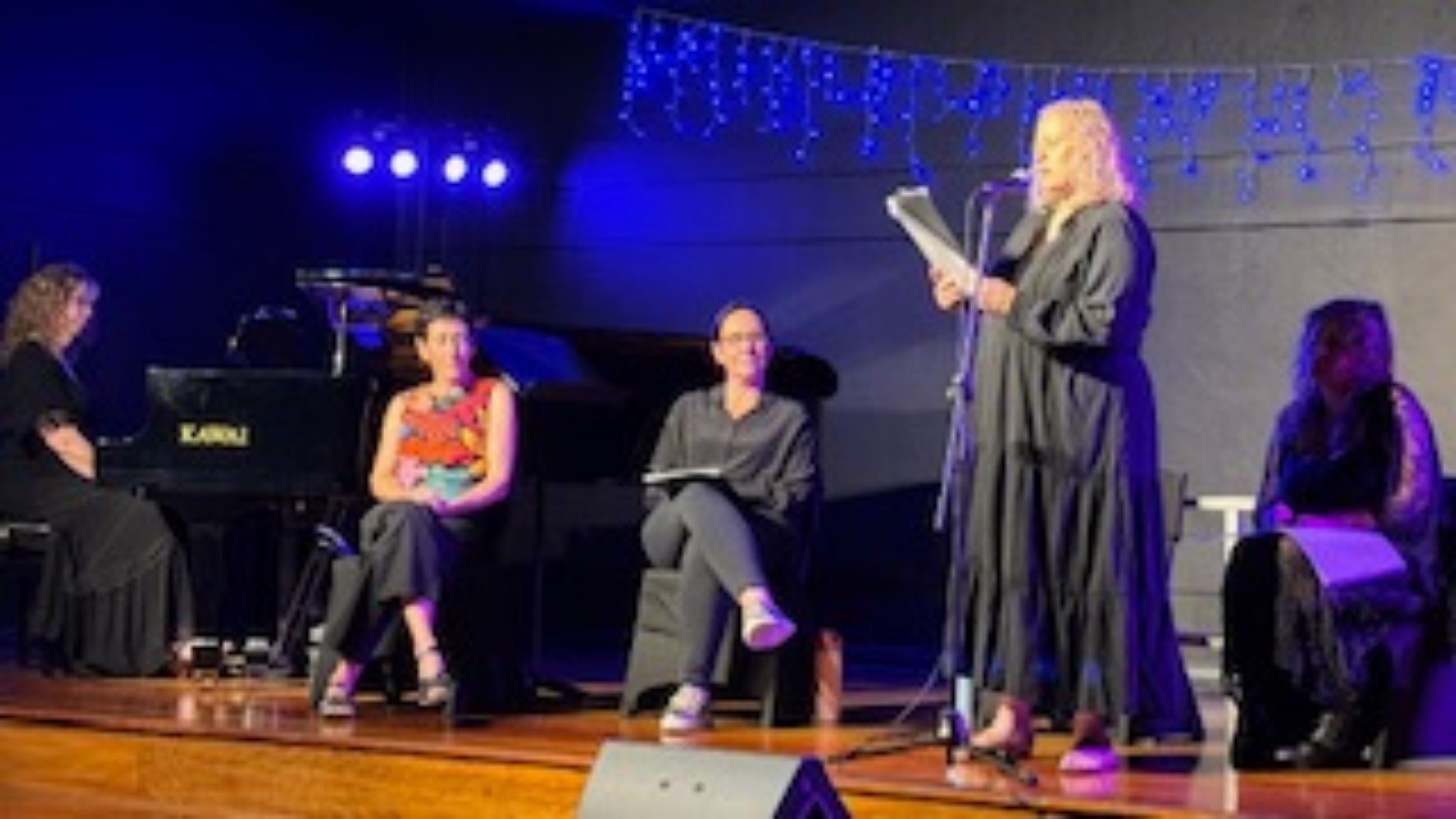
Then she came to Dubbo for Opening Night.
Erifili Davies had curated the local works. Rachael Beck brought performance and music. Eleanor brought the writer’s eye for the archive, the missing voice and the imaginative possibility inside historical material.
And around them were women from this region answering the brief in their own forms.
The interesting thing was not bringing a writer from Sydney to tell regional women how to make art. It was putting different women’s ways of making meaning beside one another.
THE LONG INTERVIEW
Maybe a friendship is just an interview you never formally finish.
That is probably why Eleanor belongs in this first edition of The Orana Woman.
Not because she is a novelist and therefore we need a novelist.
Because her story shows what this platform is trying to do.
The first conversation does not have to contain the whole person.
You can come back.
The young mothers become women with older children. The emerging writer publishes another book. The interviewer moves towns. A strange photograph becomes the seed of a completely different community event. A friendship formed in Sydney turns up years later in a theatre in Dubbo.
Nothing needs to have been planned for it to have continuity.
CUL-DE-SAC
And the next book arrives.
In September 2026, Eleanor’s fifth novel, Cul-de-Sac, is due from Ultimo Press.
Its central character, Jacquie, finds herself caught between the picture-perfect life visible from outside and the controlling reality inside it. A trip back to Australia with her children forces the question of what safety, home and freedom actually mean when leaving is not simple.
Different book. Familiar Eleanor territory.
Look behind the surface.
Ask what the official picture leaves out.
Stay long enough for the more complicated story to emerge.
WRITING WOMEN, MEMORY AND PLACE
Some stories travel further than you realise when you first hear them.
That fighter-jet photograph travelled.
So did the interviews.
So did a friendship that began when our children were small.
They travelled from Sydney into Dubbo Slide Night, into conversations about creativity and uncertainty, into a regional women’s Festival and eventually into Inspired by Her.
That is the kind of relationship I want The Orana Woman to keep making visible.
Ask the question. Keep the photograph. Come back years later. There may still be another story waiting inside it.
— Sharon