THE ORIGINAL QUESTION
Did I really choose this?
The Taco’Bout conversation began with free will and quickly wandered into conditioning, identity and the stories underneath our decisions.
HOW WE MET
One woman recommended another.
Renee Webster introduced me to Vianney and recommended her for Taco’Bout. It is one of those small relationship threads that has quietly shaped Social Gain from the beginning.
HOW VIANNEY CAME TO THE TABLE
A lot of the best people in my world arrive through another person.
That is exactly how I met Vianney.
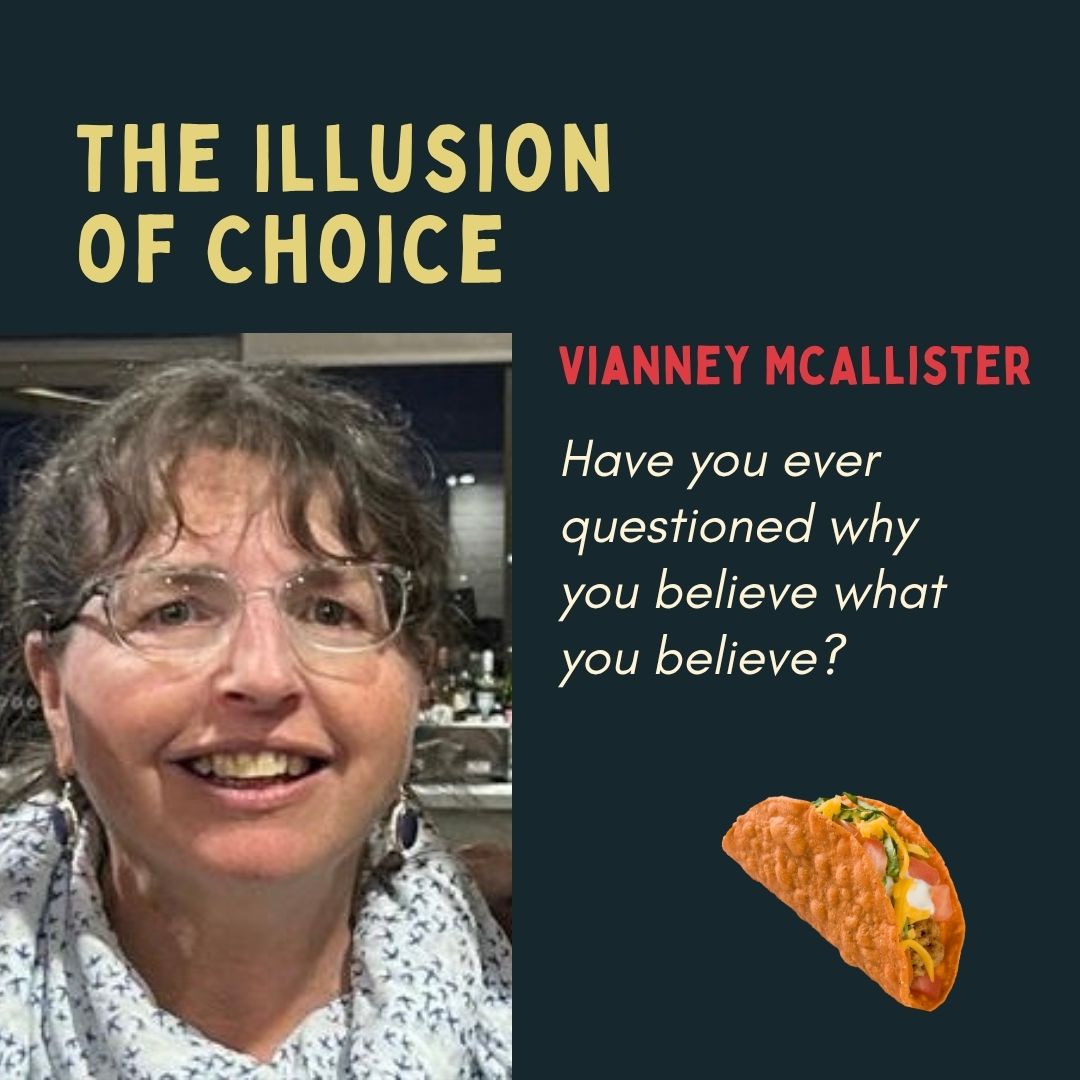
Renee Webster introduced us and recommended Vianney as someone who would be great for Taco’Bout.
Renee had already sat at the table for our very first conversation about identity, so I trusted the recommendation. And it is a lovely example of how these things tend to grow: one conversation leads to a person, that person leads to another person, and suddenly the room gets bigger.
With Vianney, the question that came into the room was choice.
Sometimes collaboration is as simple as saying: you two should talk.
THE ILLUSION OF CHOICE
We like to think our choices belong neatly to us.
I chose the job.
I chose the relationship.
I chose to stay. I chose to leave. I chose the way I parent, work, react, speak up, keep quiet, cope and carry on.
Then Vianney McAllister comes along and makes the whole thing wonderfully less tidy.
Our Taco’Bout was called The Illusion of Choice, and the question underneath it was simple enough to make your head hurt: how much of what we call personal choice was already being shaped before we consciously made it?
What if understanding what shaped us does not take away our agency — but gives us a little more of it?
THE THINGS WE ABSORB
Nobody arrives in adulthood as a blank page.
Family shapes us.
Culture shapes us.
Money. Gender. Place. Religion. School. Relationships. Belonging. Fear. The things that were praised. The things that were punished. The things nobody ever said out loud.
We absorb ideas about what a good woman looks like, what success looks like, what love looks like, what motherhood looks like, what strength looks like and how much of ourselves we are supposed to give away before we are allowed to call ourselves generous.
Even when we consciously reject those scripts, they can still be somewhere in the room.
Sometimes the most interesting thing about a choice is the story that made one option feel possible and another feel impossible.
A LONG VIEW OF PEOPLE
Vianney has spent decades close to people when life changes shape.
She is publicly listed as a transpersonal counsellor through Inner Connection Counselling.
Her public professional history also carries nursing and midwifery credentials, and that matters to me because it means the ideas are not floating somewhere above real life.
Birth. Family. Health. Grief. Change. Identity. Bodies. Relationships. The times we think we know exactly who we are and the times the answer suddenly stops working.
That is a lot of human behaviour to sit beside.
And transpersonal counselling itself takes a whole-person view — not simply what somebody is doing, but the experience, meaning, relationships and inner life around it.
Human behaviour makes much more sense when we become curious about the human experience underneath it.
WOMEN AND THE GOOD-GIRL SCRIPT
Choice becomes particularly interesting when you look at the expectations women inherit.
Be capable.
Be kind.
Do not be difficult.
Be independent, but not threatening. Ambitious, but still available. Attractive, but not vain. Maternal, even if motherhood is complicated. Strong, but preferably in a way that remains convenient for everybody else.
No wonder some of our choices come with such strange emotional luggage.
The useful question may not be: Was this really my choice?
It might be: What helped shape this choice — and now that I can see more of that, what do I want to do next?
STILL BEING HUMAN
Awareness does not magically turn us into perfectly rational creatures.
We can know a pattern and repeat it.
Know better and still not be ready.
Be brave and frightened at exactly the same time.
Love someone and need distance. Want change and resist it. Make a choice freely while also recognising all the history standing behind it.
That is not a flaw in the theory.
That is the experience of being human.
Maybe freedom is not having no conditioning at all. Maybe it is seeing a little more clearly what is in the room when we choose.
— Sharon