SHARON'S JOURNAL
Why this exists
Writing · people · place · community · creativity
“Being human is the cut-through.”
WHY THIS EXISTS
The person beside the headline
I've always been more interested in the person beside the headline than the headline itself.
Who are you really? What do you care about? Who helped you get there? Who do you help? What do you do when nobody is writing a bio about you?
Those are the questions I love.
They are also, in a very roundabout way, how The Orana Woman came to be.
Long before I moved to Dubbo, I spent years writing about people. Sydney Mum was my independent publishing platform for nine years. I started it when my own children were little and, while motherhood was the common ground, what I really loved was profiling people. Everyone had a story. The useful bit was finding the question that opened it.
At the same time, I ran Sydney Writer for fifteen years. A lot of my clients were psychologists, therapists, coaches and wellbeing people — people whose work was essentially helping other humans navigate life a little better. My job was to take what they knew and make it sound like something an actual person might want to read.
That has probably shaped me more than I realised.
I moved to Dubbo in January 2020 and, once I was here, I kept doing what I had always done: noticing people.
My first Dubbo event was Slide Night. One person. One photograph. One story.
The idea had grown out of years of interviews and the realisation that a single image can get you somewhere a formal biography never will. Put very different people in the same room, let each of them bring their people, and by the end of the night the room knows one another differently.
That was Better Together before I had properly named it.
“The best stories are already here. This is our way of paying attention.”
HOW IT BEGAN
A conversation became a Festival
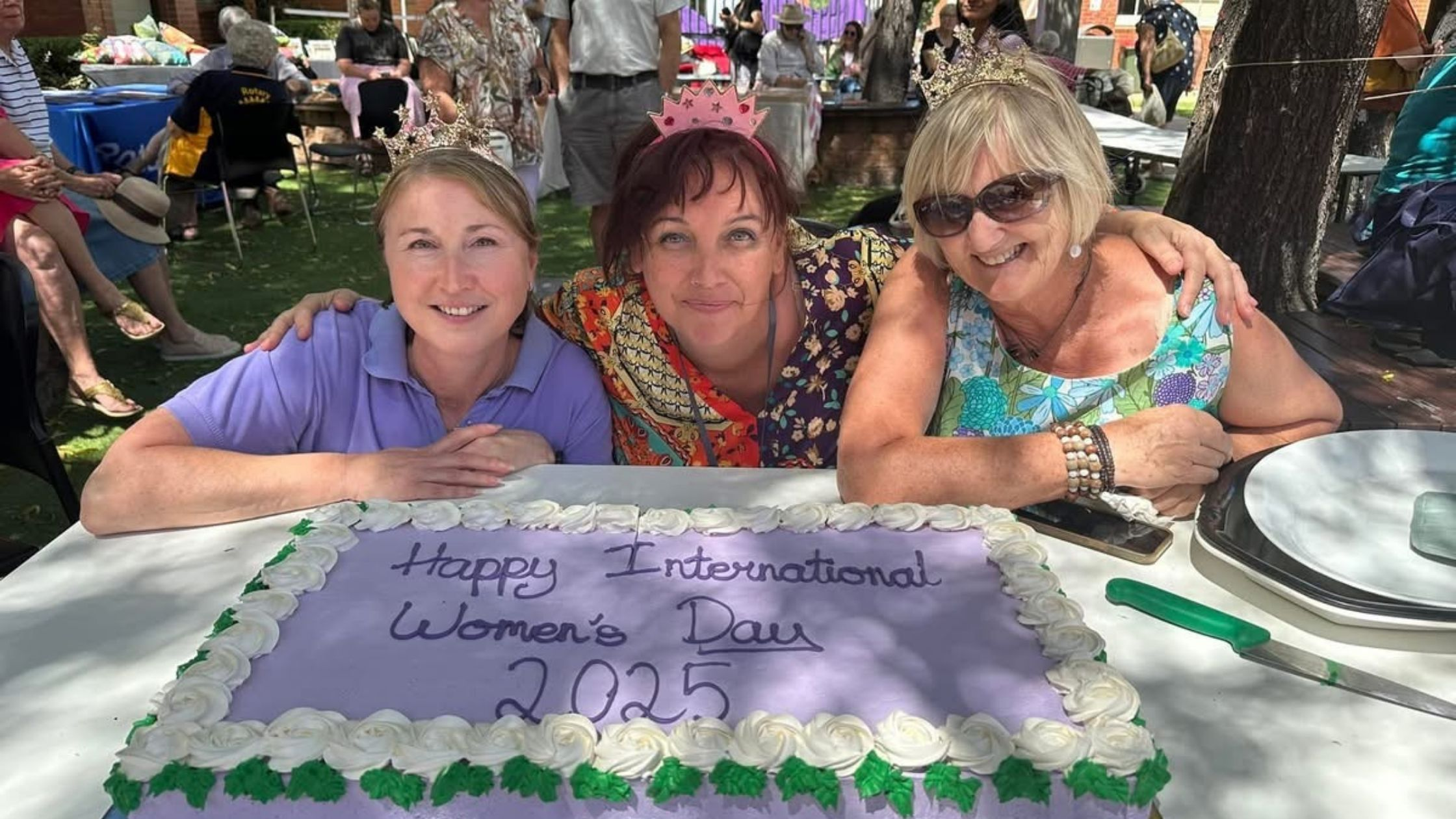
Then came the women's festival — which, fittingly, started in a conversation.
My friend Lorna Brennan was organising something for Mental Health Month and asked if I could do something for it. I told her about Susanne North, one of my Sydney Writer clients, who did menopause talks and women's events in Sydney. I'd been thinking it would be great to bring her to Dubbo.
Lorna and I kept talking.
At some point the conversation became: why are we all doing separate International Women's Day things? Why don't we create the space and let everyone bring what they already do well?
And suddenly we were doing the Dubbo Women's Festival.
Lorna and Joanne Phillips co-managed those first two festivals with me. Joanne — Nurse Jo — brought twenty years of women's-health experience and relationships. The panels sat under the loose banner of the seasons of a woman's life. We talked about menopause. Periods. Health. Bodies. Things women often want to know about but don't necessarily want delivered at them from a lectern.
I compèred and asked the serious questions, the embarrassing questions and the questions people were probably thinking but were too polite to ask.
The professionals were there. The services were there. Support was there.
But so was music and creativity and food and laughter and women talking to one another.
That was the point.
Services take part in expos all the time. What interested me was whether we could build a room where a woman could come because she wanted a lovely day with her friends — and, if she happened to need a financial counsellor, a health professional, family support or somewhere safe to ask a question, the right people were already there.
She didn't have to announce a problem to enter the room.
She could come as she was and take what she needed.
The Moment Lounge, which ran across those first two single-day festivals, came from the same thinking. Rose Prout and Charnie Tuckey were the first two businesswomen to financially back the Festival. Erifili Davies and Studio 138 brought the film layer. The idea was simple: calm and meditation do not have to be another thing you buy, another group you join or another place you have to get to. You can find a moment in the middle of your actual day.
Being human is the cut-through.
That sentence probably explains Social Gain better than most strategy documents ever will.
“She could come as she was and take what she needed.”
BETTER TOGETHER
Being human is the cut-through
After the first Festival I briefly thought: we should do a men's festival.
Then I realised what I was actually interested in was bigger than that.
How do we improve wellbeing across the whole community? How do we stop duplicating effort? How do we create a reason for people, services, business, arts, media and community to come into the same space? How do we use creativity and common ground to make important things easier to enter?
That became Better Together.
Not “everyone agrees”. Not “one organisation owns it”. Not another committee.
Better Together, to me, is much more practical: don't waste what is already good. Connect it. Amplify it. Make it easier for people to find one another.
The Festival kept growing. In 2026, the Orana Every Woman Festival ran across seven days, with five days of free programming alongside ticketed events and more than fifteen organisations involved.
That scale was partly creative ambition and partly reality: if something is going to survive, it has to be sustainable. I could not keep building a Festival that relied on me doing endless unpaid work.
“Don’t waste what is already good. Connect it. Amplify it.”
THE OTHER FIFTY-ONE WEEKS
The Festival gives us the room. The Orana Woman gives us the rest of the year.
But growth also exposed the next problem.
A Festival is a week.
What about the other fifty-one?
What about the woman who cannot get there? The person who hears about someone interesting after the event? The artist whose work disappears once the exhibition comes down? The conversation that should keep going? The women who would never call themselves “inspiring” but quietly hold up families, businesses, classrooms, services, arts organisations and communities every day?
That is The Orana Woman.
The Festival gives us the room.
The Orana Woman gives us the rest of the year.
And, for me, it brings everything back to what I love most: writing, interviewing, profiling people and following the threads between them.
This is not meant to become a directory of “successful women”.
“The Festival gives us the room. The Orana Woman gives us the rest of the year.”
SISTERHOOD
I see you. I know what you've done.
I am much more interested in the sisterhood around the success.
Who introduced her? Who encouraged her? Who gave her the first job? Who turned up? Who shared the post? Who made the artwork? Who watched the children? Who said yes before there was proof? Who keeps the thing going?
Some of the first women you will meet here are women I know very well. Others I know through projects. Others I have interviewed over many years. And some I have not met yet.
That is important.
The Orana Woman is not a club of my friends. Knowing someone simply gives me a starting point for telling a story properly. The point is to keep widening the circle.
The line I keep coming back to for Sisterhood is:
I see you. I know what you've done. I know what you give. Let me tell people about you.
You will meet women like Lorna Brennan, whose story moves from Scotland and surveying to remote family life, playgroups, migrant families and years of making community practical.
Jo Efoti, whose life asks what “it takes a village” actually means when children need adults to do more than repeat the phrase.
Joanne Phillips, whose women's-health knowledge and relationships helped shape the Festival from the beginning.
Camilla Ward, my friend and one of my longest creative collaborators in Dubbo, who keeps making room for other voices through radio, singing, teaching and community projects.
Erifili Davies, whose creative work keeps moving between film, theatre, belonging and the stories other people carry.
Phoebe Maroulis, who crosses that lovely line between practical community support and art.
Sophia Johnson, Aunty Di and Pearl Gibbs, whose stories meet through Wambuul, Country, history and Inspired by Her.
Eleanor Limprecht, a friend from my Sydney years whose writing, interviews and a single strange photograph have travelled with me into completely different parts of this work.
Yasmin Boland, another friendship that began long before any of this and later found its way into a Festival room from London.
And plenty more.
There will also be Good Humans.
That is a Social Gain idea that is very simple: people whose work, care, creativity or consistency makes the place around them better.
“I see you. I know what you’ve done. I know what you give. Let me tell people about you.”
GOOD HUMANS
People worth noticing
Not necessarily award winners. Not necessarily the loudest person in the room. Quite often the opposite.
The person who keeps turning up. The one who makes the introduction. The one who sees something good and backs it. The teacher, artist, volunteer, editor, coach, aunt, neighbour, organiser, business owner, health worker, community person or beautifully weird local human doing something worth noticing.
So this is also an invitation.
Know a woman we should meet? Tell us.
Know a good human doing something that deserves more light? Tell us that too.
Want to write something? Photograph something? Record something? Share a local story? Send it.
“The person who keeps turning up.”
WHO WE ARE
Local. Curious. Creative.
We love art that says something data cannot.
We love a service that knows a conversation can matter as much as a brochure.
We love awkward questions asked kindly.
We love people backing other people.
We love the strange little local idea that gets strangers into the same room and has them talking by the end of the night.
We love the stories that are already here.
The best stories are already in the room.
The Orana Woman is our way of paying attention.