ONE LIFE, MANY THREADS
The Festival is not the beginning of Lorna’s story.
Remote family life. Playgroups. Early childhood. Buninyong. Migrant families. Jo Efoti. Mental Health Month. The Festival. Every Woman Circles.
“Community is a practice.”
Usually because somebody has done the unglamorous bit.
BEFORE THE FESTIVAL
There was isolation. Then there was a playgroup.
Long before Buninyong. Long before the Dubbo Women’s Festival. Long before Better Together had a name.
There was isolation.
Lorna grew up in Scotland and trained in surveying and land economics before life took her a very long way from where she started. She moved into remote western NSW family life, on a property near Brewarrina, with young children and the practical realities that come with distance.
The thing that made a difference was a mobile playgroup.
That sounds small until you have needed one.
A playgroup can look like toys on a mat and adults drinking tea. But when you are geographically isolated with small children, it can also be somewhere to be expected. Somewhere your child gets to see other children. Somewhere another adult asks how you are. Somewhere the week has shape.
For Lorna, that experience became more than a lifeline. It changed direction.
She retrained in early childhood and moved into the kind of work that sits close to families: supported playgroups, practical help, introductions, transport, the small pieces of access that can decide whether someone is able to participate at all.
MAKING ACCESS PRACTICAL
Somebody has to do the unglamorous bit.
Community is very easy to romanticise.
We talk about belonging and connection as though they happen because everyone has good intentions.
Usually, they happen because somebody has done the unglamorous bit.
Somebody has remembered the time. Found the room. Organised the bus. Made the phone call. Explained the form. Put the kettle on. Noticed who did not come back. Asked why.
At Buninyong Public School, through the School as Community Centre work, that practical instinct became part of Lorna’s everyday life.
Her work included families who were new to Dubbo and new to Australia, women building conversational English, connections into TAFE and services, and the logistics of getting people to the places that could actually help them.
The important part is not the list of services.
It is the bridge.
A service can exist and still be inaccessible. A class can be available and still be impossible to attend. Information can be technically public and still not reach the person who needs it.
Lorna’s work has often lived in that space between “available” and “actually able to use it”.
That is community work.
LORNA + JO
The work that predates the project.
This is also where Jo Efoti enters Lorna’s story.
Long before Social Gain put either of them into an article, Lorna and Jo were already sitting alongside families through the School as Community Centre playgroup at Buninyong.
That matters because it changes the way we tell the later Festival story.
The Festival did not create their partnership. It did not introduce two community women and invent something clever for a program. The relationship was already there.
Years of families. Children. Conversations. Worry. Laughter. Cups of tea. Practical problems. People arriving in different states of chaos.
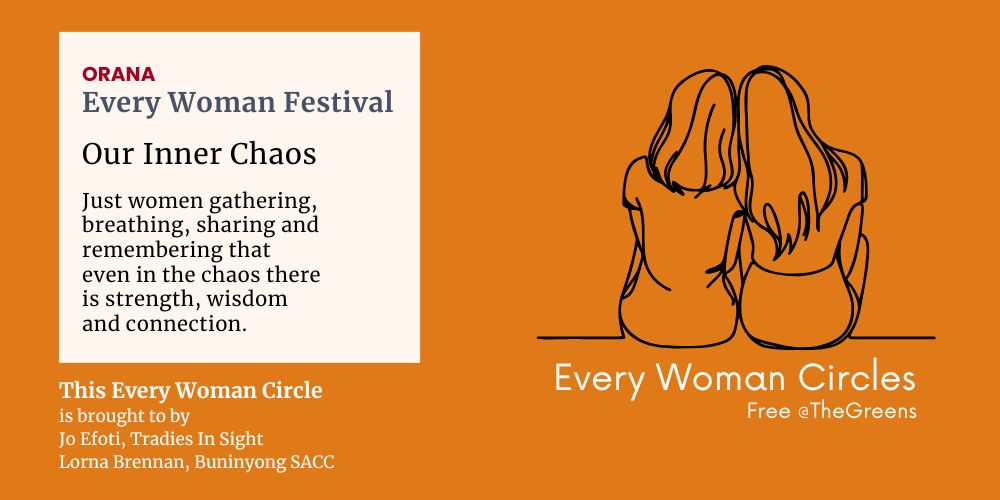
By the time Jo and Lorna later sat together in an Every Woman Circle called Our Inner Chaos, the trust underneath that conversation had been built somewhere else, over time.
Find what is already real and give it another useful place to happen.
THE FESTIVAL
The conversation that became a Festival.
The Dubbo Women’s Festival began in the same unforced way.
Lorna was organising something for Mental Health Month and asked Sharon Quill if she could do something.
Sharon mentioned Susanne North, a Sydney Writer client who had done menopause talks and women’s events in Sydney, and an idea she had been carrying about bringing that sort of conversation to Dubbo.
They kept talking.
Then came the question: why are we all doing separate International Women’s Day things?
Why not make one shared day and let people bring what they already do well?
Lorna, Sharon and Joanne “Nurse Jo” Phillips became the three women who built the first Dubbo Women’s Festival.
Again, the strength was not that they were alike.
Lorna brought deep family and community relationships. Joanne brought women’s-health experience and a trusted local health network. Sharon brought communications, promotion and the shared-space idea.
Different skills. Different networks. One room.
Lorna co-managed the first two Festivals.
And if you look at the early event through the lens of her story, you can see why it worked the way it did.
It was not built around asking women to identify as a problem first.
You could come for lunch. Music. Conversation. A health panel. A sing-along. A quiet moment. You could use a service or not use a service. You could talk deeply or barely talk at all.
The point was to make participation easier.
That is a very Lorna idea, even when nobody calls it that.
THE VILLAGE
What a village actually looks like.
We use the word village a lot. Usually when we are talking about children. Sometimes when we are talking about women. Often when we are trying to describe a feeling of community that we wish existed more reliably than it does.
Lorna’s life makes the word much more practical.
A village is the mobile playgroup that breaks isolation.
It is the person who notices a mother cannot get to a class and works out the transport.
It is conversational English that makes the next conversation less intimidating.
It is a school becoming more than a school because families need more than one doorway.
It is sitting beside the same people long enough for trust to become ordinary.
It is saying yes to a Mental Health Month conversation and accidentally helping start a Festival.
It is returning years later to sit in a circle with someone you were already doing the work with long before anyone gave it an event name.
That is why Lorna belongs in the first edition of The Orana Woman.
Not because she helped put on a Festival, although she did.
Because the Festival is only one visible piece of the story.
The deeper story is years of making community practical.
Community is a practice.
And a village is not built by saying we should have one.
It is built by people who keep doing the next useful thing.
— The Orana Woman